Google's Project Genie Creates Infinite AI Game Worlds From Text—Here's What It Means for Gaming
Google DeepMind has unveiled Project Genie, an experimental AI model that generates fully playable 2D game worlds from nothing more than text descriptions or reference images. This isn’t just another AI demo – it’s a glimpse into a future where anyone can create interactive video games without coding, artistic skills, or game development experience.
Announced as part of Google’s ongoing research into generative AI, Project Genie represents a fundamental shift in how games could be created and experienced. Instead of spending months or years developing game environments, creators can now describe their vision in plain language and watch as AI brings it to life in real-time.
What Exactly Is Project Genie?
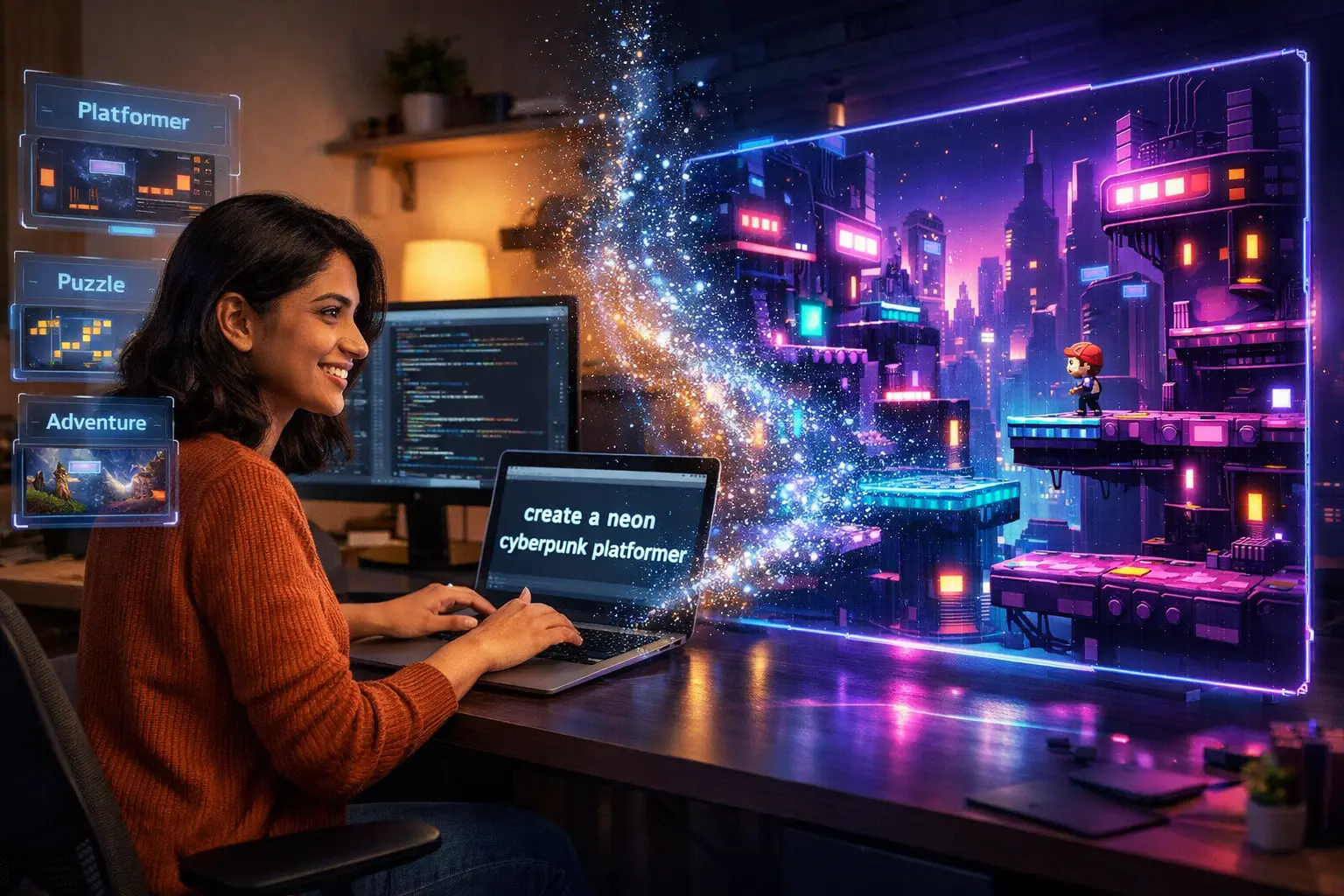
Project Genie is a foundation world model – essentially an AI system trained on vast amounts of video game footage that understands how interactive 2D environments work. Feed it a text prompt like “a platformer set in a futuristic neon city” or “a puzzle game in an underwater cave,” and it generates playable game levels that respond to player input.
Key capabilities:
- Generates game environments from text descriptions or single reference images
- Creates interactive worlds that respond to player actions in real-time
- Produces infinite variations – no two generated worlds are identical
- Maintains consistency across frames as players move through environments
- Supports basic game mechanics like jumping, moving, and interacting with objects
The technology builds on Google DeepMind’s earlier work with Genie 1, which could generate playable platformers from a single image. Project Genie takes this several steps further by accepting text inputs and creating more diverse game genres beyond simple platformers.
How Does Project Genie Actually Work?
Unlike traditional game engines that require programming and asset creation, Project Genie uses what researchers call a “generative interactive environment” approach. The AI model was trained by watching thousands of hours of gameplay footage, learning the visual patterns, physics rules, and interaction mechanics that make games feel responsive and engaging.
When you provide a text prompt, the AI:
Step 1: Interprets your description and generates an initial game scene based on learned patterns from its training data.
Step 2: Predicts how that scene should evolve frame-by-frame as a player interacts with it -jumping over obstacles, collecting items, or navigating platforms.
Step 3: Continuously generates new frames in response to player inputs, maintaining visual coherence and game logic consistency.
Step 4: Extends the world infinitely in any direction the player explores, creating new content on-the-fly while preserving the overall aesthetic and rules.
The result feels surprisingly game-like, even though every frame is being generated by AI rather than rendered from pre-built assets. There’s an inherent unpredictability – sometimes the AI creates unexpected but interesting challenges, other times it generates bizarre or impossible geometry.
What Makes This Different From Existing Game Creation Tools?
The gaming industry already has accessible game-making tools like Unity, Unreal Engine, or simpler platforms like Roblox Studio. So what makes Project Genie significant?
Zero technical skill requirement: Traditional game engines still require learning interfaces, scripting basics, and understanding game design principles. Project Genie theoretically requires only the ability to describe what you want to create.
Instant iteration: Instead of designing, testing, adjusting, and rebuilding, creators can refine their vision through conversational prompts. “Make it darker,” “add more platforms,” “change to a forest theme” – each modification happens immediately.
Infinite variation: Every playthrough generates different layouts and challenges. This could fundamentally change game re-playability and personalization.
Exploration of impossible ideas: Game developers are constrained by budgets, timelines, and technical limitations. Project Genie lets anyone experiment with game concepts that would be impractical to develop traditionally.
However, there’s a crucial distinction: Project Genie creates experiences, not products. The generated worlds are ephemeral, experimental, and currently limited in complexity compared to professionally developed games.


Current Limitations and Challenges
Google DeepMind has been transparent about Project Genie’s experimental status and significant limitations:
Visual fidelity: Generated graphics are currently simple, resembling early 2D platformers or retro games. They lack the polish and detail of modern indie games, let alone AAA titles.
Consistency issues: The AI sometimes generates contradictory elements – platforms that appear solid but aren’t, visual styles that shift unexpectedly, or physics that behave erratically.
Limited game mechanics: Current demonstrations show basic platforming and exploration. Complex game systems like inventory management, dialogue trees, combat mechanics, or puzzle solving aren’t yet supported.
No persistence: You can’t save these worlds or share them reliably. Each generation is unique and temporary, making it impossible to create consistent, repeatable gaming experiences.
Computational cost: Running these models requires substantial processing power, making real-time generation expensive and impractical for widespread consumer use currently.
Intellectual property questions: Since the AI learned from existing games, there are unresolved questions about ownership, originality, and potential copyright concerns in generated content.
Who Could Benefit From This Technology?
Despite its experimental nature, several groups stand to gain from Project Genie’s development:
Game Designers and Developers
Rapid prototyping: Instead of spending days building a level to test a gameplay concept, designers could generate multiple variations instantly to explore different approaches.
Inspiration and ideation: Sometimes seeing unexpected AI-generated environments sparks creative ideas that designers wouldn’t have conceived traditionally.
Placeholder content: During early development stages, AI-generated environments could serve as temporary spaces while final assets are being created.
Content Creators and Streamers
Unique streaming content: Gaming streamers could create never-before-seen worlds on-demand, offering audiences genuinely unique experiences each stream.
Interactive storytelling: Creators could describe narrative scenarios and let AI generate the settings, making interactive storytelling more accessible.
Educators and Researchers
Game design education: Students can experiment with game concepts without the technical barriers of traditional game development, focusing on design thinking and player experience.
AI research: Understanding how these models generate coherent interactive environments advances broader AI research in world modeling and predictive systems.
Casual Creators and Gamers
Personal expression: People with game ideas but no technical skills could finally bring their visions to life, even if just for personal exploration.
Entertainment: The novelty of generating and exploring AI-created worlds could become its own form of entertainment, separate from traditional gaming.
The Technology Behind Generative World Models
Project Genie represents a specific category of AI called “generative world models” – systems that don’t just create static images or text, but interactive environments that respond to input.
This field has seen rapid advancement:
Genie 1 (2023): Google’s earlier model that could generate platformer games from single images, demonstrating that AI could learn game mechanics purely from observation.
Sora (OpenAI): While focused on video generation, Sora’s ability to maintain physics consistency and object permanence influenced thinking about interactive world generation.
GameNGen (Google, 2024): An AI model that could run DOOM entirely through neural networks, proving games could theoretically exist without traditional game engines.
Project Genie builds on these foundations but adds the crucial element of text-based control and infinite generation, making the technology more accessible and open-ended.
Implications for the Indian Gaming Industry
India’s gaming sector is booming, with thousands of aspiring game developers and a growing indie game scene. Project Genie-like technologies could have unique impacts here:
Lowering entry barriers: Many talented Indian developers have creative ideas but lack access to expensive game development tools or formal training. Text-to-game generation democratizes creation.
Regional content creation: Developers could more easily create games reflecting Indian culture, mythology, and stories without requiring large art teams or budgets.
Mobile-first opportunities: Since generated games could theoretically run on lower-end hardware (if optimization improves), they align well with India’s mobile-dominant gaming market.
Educational applications: Indian universities and coding bootcamps could use these tools to teach game design concepts without requiring students to master complex programming first.
However, there’s also concern about devaluing traditional game development skills just as India builds expertise in this sector.
Ethical and Creative Concerns
The gaming community has expressed mixed reactions, with several concerns dominating discussions:
Job displacement fears: If AI can generate game environments, what happens to level designers, environment artists, and game programmers? Google emphasizes these are creative tools, not replacements, but concern persists.
Homogenization of creativity: If everyone uses the same AI model trained on the same games, will generated content feel sampled and derivative rather than genuinely original?
Training data transparency: What games were used to train Project Genie? Do those original creators deserve compensation or credit when their work influenced the AI’s output?
Quality vs. accessibility trade-off: Making game creation easier is positive, but does it flood the market with low-quality experiences that dilute gaming culture?
Player experience: Are AI-generated infinite worlds actually fun to play, or do they lack the intentional design and pacing that make handcrafted games compelling?
These aren’t questions Google can answer alone – they’ll require industry-wide dialogue as the technology matures.
Comparing Project Genie to Other AI Game Tools
Project Genie isn’t the only AI tackling game creation. Here’s how it compares:
Tool/Technology | Capability | Accessibility | Output Quality |
Project Genie | Generates playable 2D worlds from text | Research only (not public) | Experimental, retro aesthetic |
Scenario.gg | AI-generated game assets (sprites, textures) | Public, subscription-based | High quality, style-consistent |
Promethean AI | AI assistant for 3D environment building | Game studios, enterprise | Professional, production-ready |
Leonardo.AI | Game asset and concept art generation | Public, freemium | Very high quality, not interactive |
Roblox AI Tools | Limited AI-assisted building within Roblox | Public, free | Moderate, within Roblox constraints |
Project Genie’s uniqueness is generating complete playable experiences end-to-end from text, rather than just assisting with specific aspects of game development.
What Happens Next: Timeline and Expectations
Google DeepMind has not announced public release plans for Project Genie. Based on similar research projects, here’s a realistic timeline:
2026 (Current Year): Research publication, limited demonstrations, academic discussions. No public access.
2027-2028: Possible limited beta testing with select developers or researchers. Refinements based on real-world use cases.
2029-2030: Potential integration into existing Google products (possibly as experimental features in Google Labs or related to Gemini AI capabilities).
2030+: If successful, could become part of accessible game creation suites, either standalone or licensed to game engine companies.
However, this assumes continued investment and successful navigation of the technical and ethical challenges. Many promising AI research projects never reach consumer products.
How You Can Experiment With Similar Technologies Now
While Project Genie isn’t publicly available, several accessible alternatives let you explore AI-generated interactive experiences:
AI Dungeon: Text-based adventure games powered by AI that generates stories and scenarios based on your inputs. Available now, free tier available.
Scenario.gg: Generate game-ready assets and sprites using AI. Indian rupee pricing available, monthly subscription ₹1,200-4,000 depending on tier.
Midjourney + Game Engines: Generate concept art and environment ideas with Midjourney, then implement in Unity or Godot (both free). This hybrid approach combines AI creativity with traditional game development.
GPT-4 + Python: Use ChatGPT to help you code simple text-based or 2D games. The AI can write game logic while you focus on design concepts.
Roblox Studio: While not purely AI-generated, Roblox’s tools are accessible enough for beginners and increasingly incorporate AI assistance features.
The Bigger Picture: AI and the Future of Interactive Media
Project Genie represents more than just a game creation tool – it’s part of a broader shift toward AI-generated interactive experiences.
Personalized entertainment: Imagine Netflix-style games that generate unique storylines and challenges based on your preferences and play style.
Educational simulations: Custom learning environments generated on-demand for specific educational objectives, making interactive learning more accessible.
Virtual world creation: The metaverse concept requires vast amounts of content. AI generation could make creating persistent virtual spaces more feasible.
Therapeutic applications: Custom environments for exposure therapy, stress relief, or cognitive rehabilitation generated based on patient needs.
The fundamental question isn’t whether AI can generate interactive worlds – Project Genie proves it can. The question is whether AI-generated experiences can match the intentionality, emotional resonance, and craft of human-created games.
Key Takeaways
- Project Genie showcases impressive technological advancement in AI-generated interactive environments, but it’s firmly in the experimental stage. The ability to create playable game worlds from text descriptions is remarkable, yet current limitations prevent it from replacing traditional game development.
- For Indian developers and gamers, this technology represents both opportunity and uncertainty. It could democratize game creation, making it accessible to those with ideas but limited technical skills. Simultaneously, it raises questions about the value of traditional development expertise and creative originality.
- The gaming industry will likely see AI as an augmentation tool rather than a replacement – helping developers prototype faster, generate variations efficiently, and explore creative directions that would be impractical otherwise. The human elements of intentional design, emotional storytelling, and crafted player experiences remain irreplaceable.
- As with all generative AI, the most exciting possibilities emerge when human creativity guides AI capabilities, rather than AI attempting to replace human creativity entirely. Project Genie is a powerful new tool in that creative toolkit, but the artist wielding it still matters most.